AOB is gone.
Since January 2023, Florida roofers can no longer bill insurers directly on new policies. You front the work. The homeowner waits on the carrier. You wait on the homeowner.
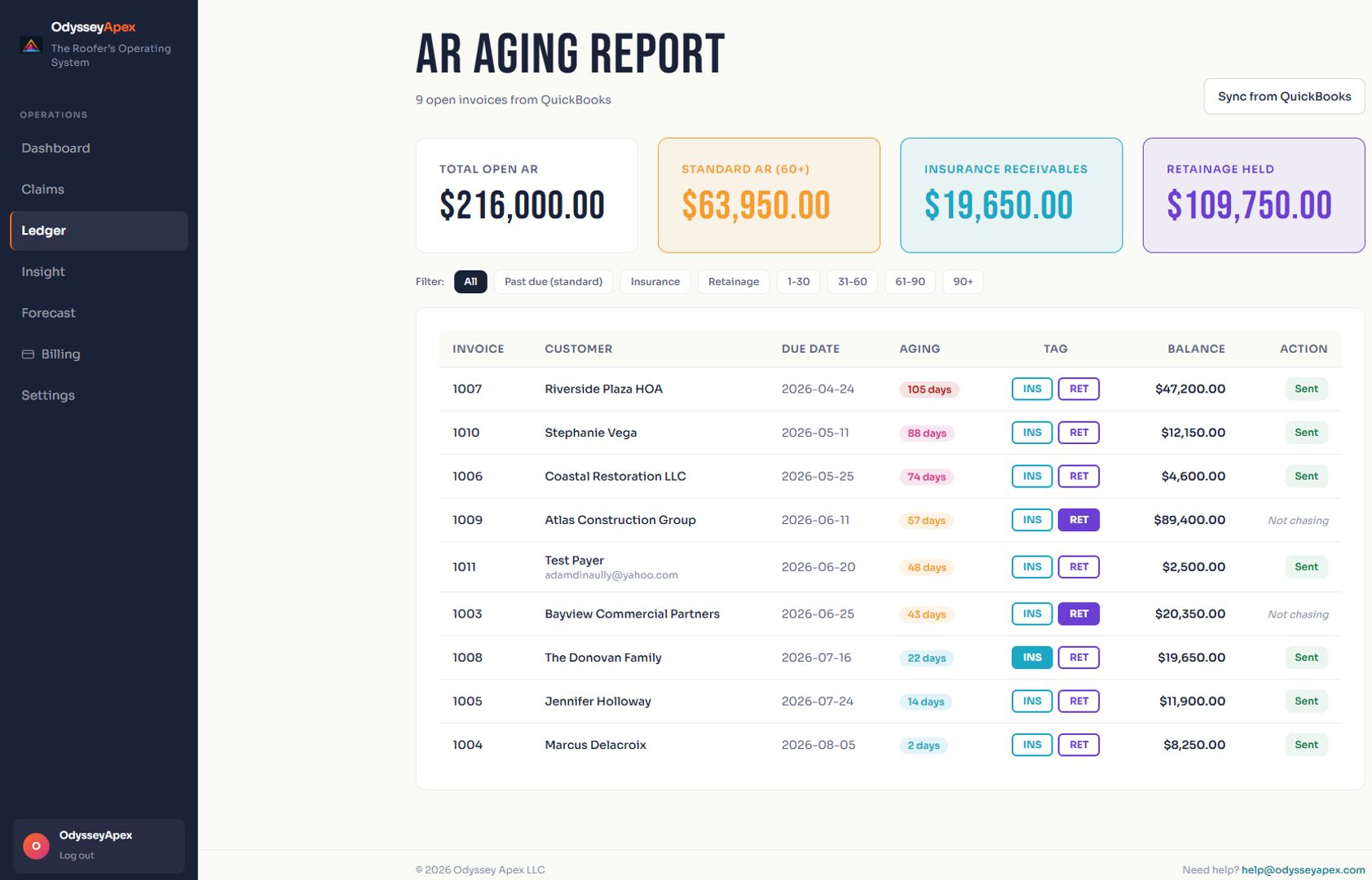
Insurance proceeds, retainage, supplements, mortgage holds, and recoverable depreciation break the way QuickBooks reports roofing money. Odyssey Apex starts with Ledger: an insurance-aware AR recovery system that reads QuickBooks Online, separates what is collectible from what is stuck, and shows your office what to chase first. Insight and Forecast extend the same financial data into live job margin and 90 day cash flow.
Want the short version?
Odyssey reads your QuickBooks Online and runs a 20 minute AR review that separates normal overdue invoices from insurance, retainage, supplement, mortgage hold, and direct pay dollars. You see what is actually collectible and what to chase first.
Since January 2023, Florida roofers can no longer bill insurers directly on new policies. You front the work. The homeowner waits on the carrier. You wait on the homeowner.
Roughly 40% of roof insurance claims close with no payout. Your open invoice report cannot tell you which of yours are in that bucket.
CSU forecasts a below-average Atlantic hurricane season. Less event revenue. More forced-replacement work with finance friction.
Born in Florida's post AOB roofing market. Built for roofers anywhere insurance, retainage, supplements, mortgage holds, and slow paying AR distort the books.
Production software runs the job. Bookkeeping records what happened. Nobody else owns the layer in between: the financial state of your business while jobs are still in motion. That is the gap. That is what Odyssey is built for.
| Capability | AccuLynx | JobNimbus | QuickBooks | Odyssey Apex |
|---|---|---|---|---|
| Job pipeline and production tracking | Yes | Yes | No | No |
| Historical bookkeeping and tax records | No | No | Yes | No |
| Tags AR as insurance, retainage, or direct | No | No | No | Yes |
| Live job profitability vs estimate | No | No | No | Yes |
| 90-day cash flow forecasting | No | No | Partial | Yes |
| Insurance, supplement, mortgage hold literacy | No | No | No | Yes |
| Real-time financial state of jobs in motion | No | No | No | Yes |
Different layers, different tools. Run jobs in AccuLynx or JobNimbus. Keep books in QuickBooks. Run the financial nerve center of the business in Odyssey.
Roofers lose more to uncollected AR than any other trade. Not because homeowners won't pay. Because supplements get delayed, mortgage companies hold funds, retainage gets forgotten, and your office manager is buried scheduling crews. The money is already cut. Somebody just has to follow up.
ACV check came in, depreciation still pending, mortgage company endorsed half the check and held the rest. Three different timelines on one job. Nobody is tracking it. So nothing moves.
She is scheduling crews, dealing with material suppliers, fielding customer calls, and chasing adjusters. AR followup is the first thing that drops when a storm rolls through.
A roofing receivable at 30 days collects at 92 percent. At 90 days you are under 70. At 120 days you are flipping a coin. Time is the killer and lien deadlines are unforgiving.
When a homeowner with a $24K storm claim signs the contract, you are not collecting from one party. You are waiting on a sequence of four parties, in order, with their own timelines, paperwork, and rules. Here is what that actually looks like on the books.
Insurance issues the first check, usually within 7 to 21 days after the adjuster's report. Pays for depreciated value of the damaged roof. On a $24K claim, this might be $14K to $18K. Co-payable to the homeowner and the mortgage company on any home with a mortgage.
If the check is over $10K to $40K depending on the lender, the mortgage company holds the funds in escrow and releases them in draws as work is completed. You submit photos, inspection reports, and W9s. They release a third, then a third, then the last third. Each release runs 5 to 15 business days.
Halfway through the roof you find rotted decking, code-required ice and water, or damaged flashing the adjuster did not include. You file a supplement. The carrier reopens the claim, sends an adjuster back out, reviews, approves, and issues a second check. This is where most roofers leave money on the table because nobody follows it.
Once the job is complete and you provide the invoice and Certificate of Completion, the carrier releases the held-back depreciation. On the same $24K claim, that is the final $6K to $10K. The homeowner forgets to send the paperwork. The mortgage company holds it again. Nobody is chasing it because the roof is already done.
This is also why retainage on commercial reroofs deserves its own treatment. A 10 percent retainage hold on a $180K commercial job is $18K that is not late, not in dispute, and not collectable until project closeout. A generic tool flags it as 90 days overdue and emails the GC a firm reminder. You just made your best customer feel like a deadbeat.
The receivables intelligence is live and working today. The deeper claim stage workflow is on the path. See the roadmap below.
Generic AR tools give you one number: "past due." Roofing money does not work that way. Plug in your insurance mix, your retainage, and your direct-pay revenue. See the cash that is actually trapped, the margin you cannot see, and how close you are running to a crunch. Instant. No email required to see your numbers.
Estimates use roofing industry benchmarks against your inputs. Actual recovery depends on insurance versus retail mix, supplement discipline, retainage cadence, and configuration.
We will email you a detailed 1 page report with your numbers, the math behind each, and a roofing-specific 5 step plan to plug the leak whether you use Odyssey or not. One follow up. Unsubscribe anytime.
Fair question. The honest answer: a general AI tool is a smart generalist. It sends a reminder. Odyssey is a specialist that understands how roofers actually get paid.
A generic tool emails the homeowner the same nag whether the money is sitting with State Farm, hung up at the mortgage company, or stuck in a supplement queue. It does not know the difference between depreciation withheld and a customer dodging you. It treats retainage on a commercial reroof as a delinquent invoice. It sends a firm followup to the GC who feeds you half your work.
Odyssey is built to know all of it. The trade. The vocabulary. The cash reality. Which customers need a scalpel and which need a hammer. Across AR, job costing, and cash forecasting, all built on the same financial primitives.
You would not let a generalist on your roof. Do not let one run the financial nerve center of your business.
The fastest way to know if this is real: put your own QuickBooks in front of it for 20 minutes.
See your numbers live →Odyssey OS is the financial operating system for roofing. Three products on one platform: Ledger watches money owed, Insight watches money made on active jobs, Forecast watches money coming. Each works alone. Together they form the financial nerve center of the business.
Real-time AR with insurance, retainage, and supplement awareness.
Tags every invoice as insurance, retainage, or direct-pay. Ages each on its own clock. Sends branded follow-ups with tone that shifts as invoices age. Knows the difference between a homeowner dodging you and a mortgage company sitting on the check. Built so your office manager doesn't have to chase what the system can chase itself.
Live job profitability tracked against your original estimate.
The moment costs hit QuickBooks, Insight compares them against the estimate on the job. Labor, materials, dump fees, overhead, all live. Two-track mode auto-detects when AP is being captured and switches from revenue-only to full margin view. You stop waiting until month-end to find out a job lost money. You find out while you can still do something about it.
Cash flow visibility 90 days out, before the crunch hits.
Combines real AR probabilities with supplement timing, material vendor cycles, and payroll to project your cash position 90 days ahead. Detects crunches before they happen. Two-track mode picks up AP automatically when costs are tagged for a full cash picture, not just collections. Stop running the business on bank balance gut-checks.
The platform thinks across products. Ledger flags feed Forecast crunches. Insight margin variance feeds Ledger priority. Forecast cash gaps surface in Ledger as collection urgency. Buy them separately and you get three good tools. Buy the OS and you get a financial nerve center.
Most roofers start with the money owed lens. It finds and prioritizes collectible AR first. Once your receivables are clean, the margin and cash flow lenses get more powerful because the same financial data powers all three. You do not have to decide on all of it today.
Odyssey Apex is onboarding a limited group of roofing contractors right now with founder led setup. Public customer stories come once that cohort has run a full season. Until then, here is the operating math behind the product for a typical $3M roofer running 55 percent insurance work.
11.8x return at the conservative end. Break-even is usually one recovered supplement or one caught margin slip. Most roofers hit it in week one.
"I built Odyssey because roofing money does not behave like normal business money, and the tools roofers are handed pretend that it does. Insurance stages, retainage, supplements, recoverable depreciation. None of it shows up cleanly in QuickBooks, and that is where the surprises come from. Seven figure operations running cash flow that swings on whether an adjuster picks up the phone. Six figures sitting in supplement queues and mortgage company holds with nobody chasing it. It is not a money problem. It is an operations problem."
"This is not an automation agency and it is not a CRM. It is the finance layer that reads your books and tells you the truth about your cash. Navy trained. Decade plus in B2B operations and sales. I have sat across from hundreds of small business owners watching them run multi-million dollar companies on systems built for a side hustle. I am not a tech founder chasing a TAM. I am an operator building the tool I watched my friends desperately need. Setup takes about a day. No long lock in. You will see the gap on your own numbers on the first call."
Adam Dinaully| Founder, Odyssey Apex
The platform ships new capability every month. Here is what's queued. Customers shape the order. If one of these matters more to you than the others, tell us on the demo.
Tag an invoice as insurance mediated and Ledger changes its language. It tracks supplement status, knows the money may come in two checks, knows the mortgage company may be holding funds, and writes followups that reflect that instead of "your invoice is overdue." A generic tool will never do this.
On commercial reroofs, retainage held until closeout is normal and not delinquent. Ledger recognizes retainage, excludes it from the overdue cadence, and tracks it separately for release. We protect your relationship with your GC. A reminder engine structurally cannot.
Flag a customer as "referral source, handle with care" or "repeat commercial, never go firm." The fear that stops roofers from automating collections is "this thing is going to email my biggest customer something rude and I lose them." Ledger gives you a scalpel, not a switch.
When a customer replies "waiting on my insurance check" or "the adjuster has not approved the supplement," that is a status update, not a dispute. Ledger learns the actual vocabulary of roofing payment delays and routes accordingly. Built for roofing, not for everything.
Mechanics lien deadlines are state specific and brutal. Miss the window and the receivable's leverage evaporates. Ledger surfaces "this invoice is approaching the lien deadline in your state, here is the date." Not a reminder tool. A risk management tool.
Direct, sanctioned integration. Not a scraper. Not a workaround.
All customer data encrypted at rest and in transit.
Card data never touches our servers. Industry standard PCI compliance.
We never write to your QuickBooks without your explicit configuration.
Export at any time. Delete on cancellation. No retention games.
No annual contract. No early termination fees. No friction.
Odyssey Apex is a financial operating system for roofing contractors using QuickBooks Online. It reads your books and turns roofing financial data into operational decisions: which receivables are actually collectible, which jobs are bleeding margin, and when cash really lands. It watches money owed, money made on active jobs, and money coming over the next 90 days.
No. Odyssey reads QuickBooks Online through the sanctioned API and turns roofing financial data into operational decisions. QuickBooks stays your accounting system. Read only by default. Your data stays yours and you can export at any time.
No. AccuLynx and JobNimbus manage production: the pipeline, the crews, the job on the roof. Odyssey manages the financial state of those jobs: receivables, profitability, and cash flow. They run the work. Odyssey owns the money layer in between production and bookkeeping.
Roofing contractors doing roughly $1 million to $20 million in annual revenue who use QuickBooks Online and deal with insurance payments, retainage, supplements, overdue AR, or cash flow swings. Residential, storm restoration, commercial, or any mix, with crews under 50, across the United States.
A roofing receivable is not a normal receivable. On an insurance claim you wait on a sequence of four parties: the ACV check, the mortgage company endorsement, the supplement carrier review, and the depreciation release at job completion. A single $24K claim can run 90 to 180 days end to end. Retainage on commercial reroofs is held money, not delinquent money. A generic AR tool cannot tell the difference. Odyssey is built to.
Each of the three products is $497 per month or $4,997 per year. The full platform bundle is $1,200 per month or $11,997 per year. Most roofers start with one product, get their receivables clean, then expand. Cancel anytime. No setup fee, no early termination fees.
Twenty minutes. Your numbers. No pitch deck. Odyssey reads your QuickBooks Online, sorts your receivables by what is actually collectible, scores how much of your books you can trust, and shows you where cash and margin are leaking right now. If the gap is not real, you will know inside the first five minutes and we both move on.
No card. No commitment. Setup takes about a day if you move forward.